
News and insights
How BESS Protects Energy Security and Reduces Costs
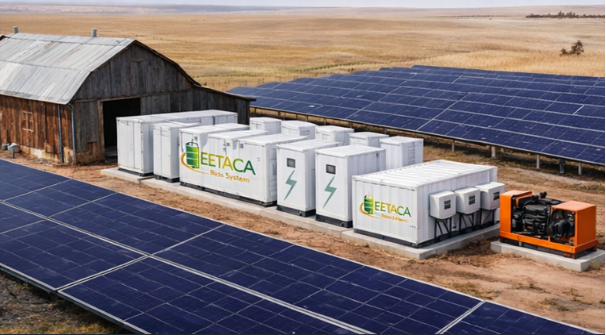
Electricity costs, supply interruptions and growing pressure to improve energy performance are pushing many organisations to look beyond conventional grid supply. In practice, relying only on the grid often means higher exposure to price volatility, limited control over peak demand and a greater risk of operational disruption when power quality drops or outages occur.
When these issues are not addressed in a structured way, businesses continue paying for avoidable inefficiencies. Diesel generators are used more often than necessary, solar production is not fully utilised, and critical operations remain exposed to interruptions that can affect productivity, service continuity and maintenance costs.
EETACA’s battery energy storage and microgrid approach is designed to address these problems by combining local generation, battery storage and intelligent energy management into one coordinated system. In practical terms, this allows organisations to reduce peak demand, improve the use of onsite renewable energy, limit generator runtime and maintain continuity during grid disturbances or islanding operation.
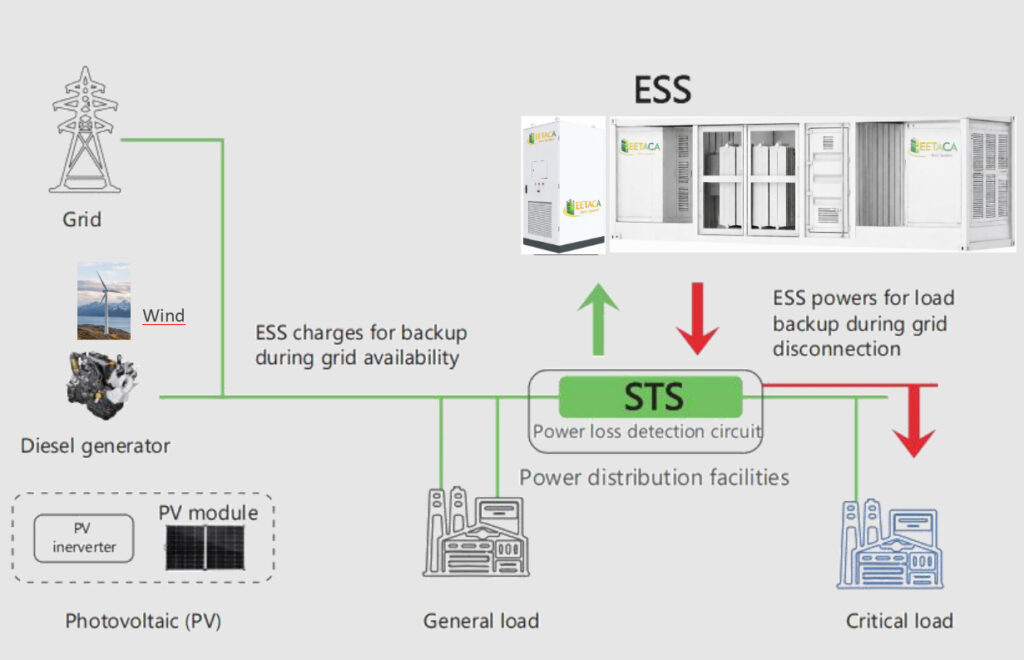
Improving energy resilience with microgrid architecture
A microgrid is a small-scale electricity system that combines local energy sources, storage and control systems to serve onsite loads while remaining connected to the main electricity grid when needed. It can also operate independently in islanding mode, which means local users can continue supplying critical loads even when the external grid is unavailable.
This changes the role of energy infrastructure from a passive utility connection to an actively managed system. Instead of simply consuming electricity from the grid and using backup generation only in emergencies, the site can coordinate solar generation, battery charging and discharging, and conventional backup assets as part of a single operating strategy.
In practical terms, this creates a more resilient energy model. Critical loads can be supported during outages, local generation can be used more efficiently, and the site gains greater flexibility in how and when energy is consumed, stored or exported.
Reducing energy costs through peak shaving and smarter load management
In many commercial and industrial sites, a significant share of electricity cost is linked not only to total consumption but also to when that consumption takes place. Short periods of high demand can increase charges disproportionately, especially where tariffs include demand components or where large loads create stress on the electrical connection.
Battery storage helps address this by shifting energy in time. The system can charge when cheaper or surplus energy is available and discharge during peak periods, reducing the highest load seen by the grid connection. In the proposal, this is reflected in functions such as peak shaving, smart load management and cost optimisation.
This matters because the benefit is not limited to the electricity bill alone. Lower peak demand can also reduce stress on infrastructure, improve overall energy planning and make it easier to integrate more renewable generation without destabilising site operations. In practice, this supports a more predictable cost base and better return on energy investments.
Using solar, storage and diesel in a more efficient way
Many sites already have or are considering a mix of solar generation, battery storage and diesel backup. The challenge is that these assets often operate separately or with only limited coordination. As a result, solar power may be curtailed or underused, batteries may not be dispatched at the right times, and diesel generators may run longer than necessary.
The uploaded proposal positions the microgrid solution precisely around this integration challenge. For commercial applications such as farms, shopping centres, logistics hubs and community complexes, the system is presented as a way to combine solar, storage and diesel into a more flexible and sustainable power solution. For industrial functions, it emphasises uninterrupted power, fuel and operating cost savings, and resilient operations.
In practice, this means the energy system can be managed according to real operating priorities. Solar generation can be maximised, batteries can absorb and release energy where they add most value, and diesel use can be reduced to the situations where it is genuinely needed. The result is lower fuel consumption, lower operating costs and a more controlled path toward decarbonisation.
Getting the data needed to choose the right actions
In many companies, energy costs are only visible as a monthly figure per site. This makes it hard to know which lines, utilities or processes are responsible for most of the consumption, and which part of that consumption is actually avoidable. As a result, decisions about improvements are often based on assumptions or on what is most visible, such as lighting, rather than on what really drives the bill. Money can be spent on projects that look good but do not significantly change total costs, while more important sources of waste remain untouched.
Smart energy projects include a step focused on metering and basic analysis. Existing meters are used in a more systematic way and, where useful, a limited number of additional measurements are installed on key equipment or utilities such as compressed air, steam, chilled water or specific production lines. The goal is not to measure everything, but to have enough information to compare options and confirm results.
With this level of data, it becomes possible to see how consumption changes with production, to identify periods or areas of unnecessary use and to quantify the effect of individual measures. Investment decisions can then be supported by figures instead of estimates, and the impact of completed projects can be tracked over time. This reduces the risk of backing ineffective actions and helps to focus budget and attention on interventions that bring real and measurable savings.
Protecting critical operations during outages and disturbances
For many organisations, the most serious energy issue is not cost alone but continuity. Short interruptions, voltage instability or longer outages can damage equipment, interrupt production, affect refrigeration or IT systems, and create service failures that are more expensive than the energy bill itself.
The proposal addresses this through uninterrupted power capability and seamless switchover to protect critical equipment. It also describes resilient operations and continuity during outages as core benefits of the solution. Because the microgrid can operate in islanding mode, the site is not fully dependent on external grid conditions when continuity is essential.
This is especially relevant for industrial sites and other operations where downtime quickly becomes costly. In practical terms, energy storage becomes part of business continuity, helping keep priority loads online, reducing the impact of disturbances and supporting a more stable operating environment for sensitive processes.
Choosing systems that are scalable and technically robust
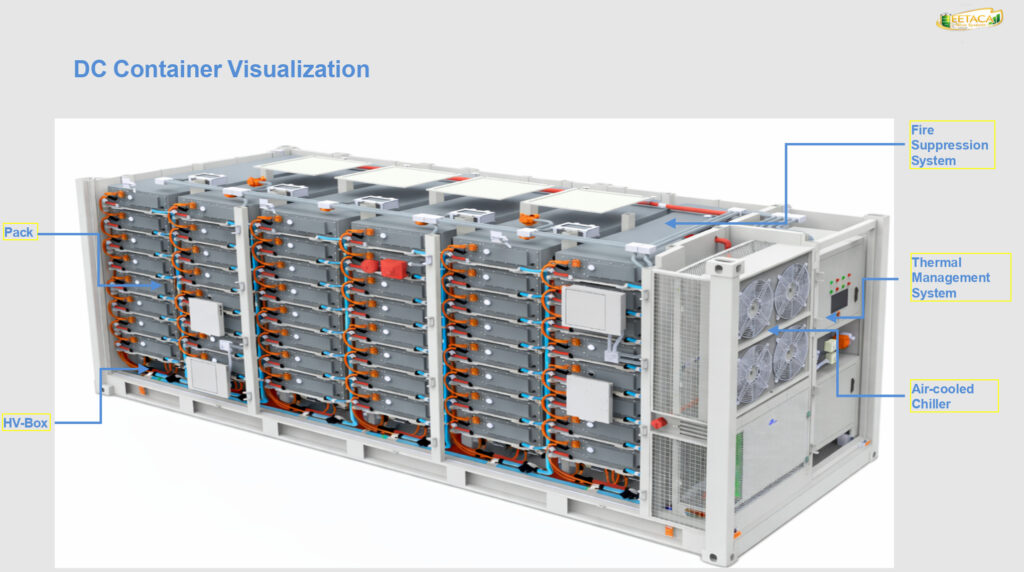
Energy infrastructure projects often fail to deliver long-term value when they are sized only for the present moment. Load profiles change, onsite generation expands, and new operational requirements emerge over time. A rigid system can therefore become a limitation rather than an asset.
The proposal highlights modular design and scalable expansion as part of the microgrid concept. It also provides detailed component and container specifications, including liquid-cooled battery configurations, PCS skid container characteristics, operating temperature ranges, ingress protection ratings, communication modes and compliance references. These details show that the project is not only a conceptual energy solution but a technically defined system architecture intended for real deployment conditions.
In practical terms, scalability matters because it allows organisations to start with a system matched to current needs while preserving the option to expand capacity later. This reduces the risk of overbuilding too early, while still supporting future demand growth, renewable integration or resilience requirements.
Supporting long-term performance with warranty, maintenance and training
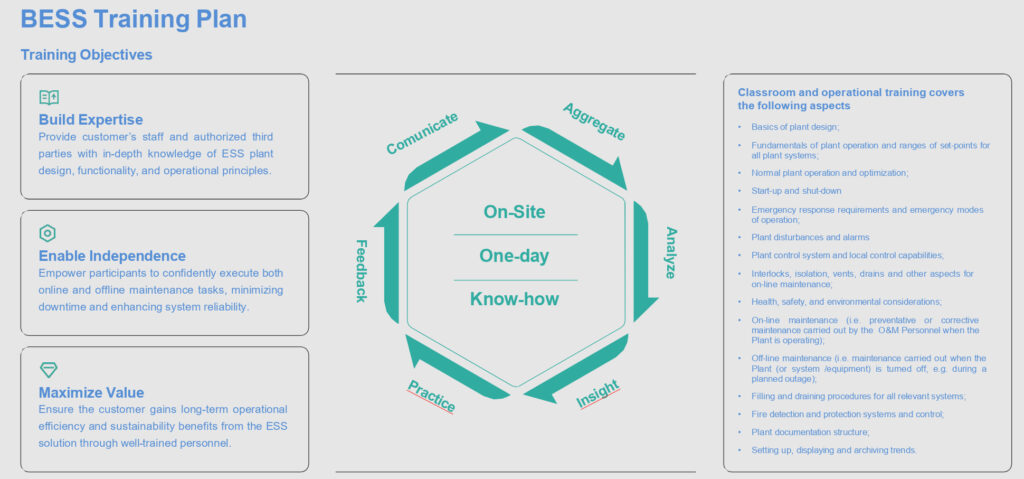
The value of a battery storage project depends not only on equipment performance at commissioning but also on how reliably the system operates over time. Without clear service arrangements, maintenance routines and operator knowledge, even a well-designed installation can underperform.
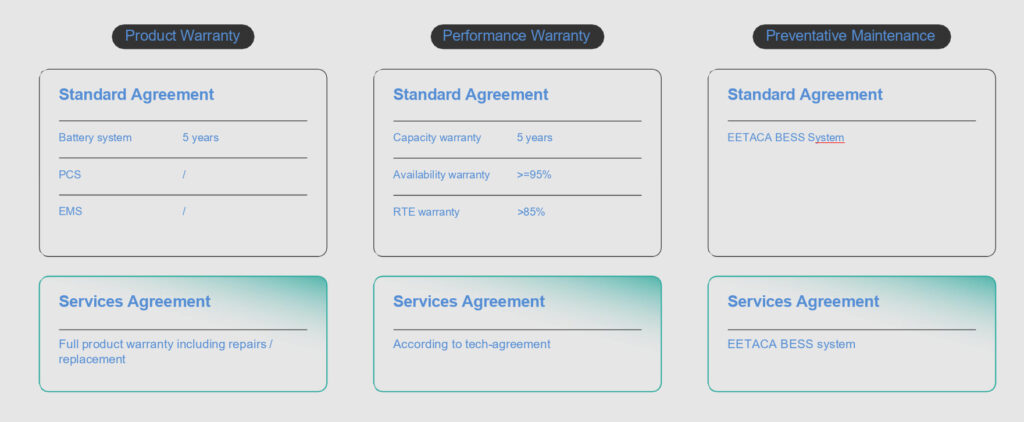
Your proposal addresses this through warranty and service elements, including product warranty, capacity warranty, availability targets, maintenance agreements and structured training. The training plan covers plant design, operation, emergency response, alarms, maintenance practices, safety and documentation, with the stated aim of building expertise, enabling independence and maximising long-term value for the customer.
This is important because energy storage systems are operational assets, not just installed hardware. In practice, a trained customer team, clear service framework and preventative maintenance approach help reduce downtime, improve reliability and support the long-term efficiency of the system throughout its operating life.
Addressing cybersecurity and data resilience in energy systems
As energy systems become more digital, cybersecurity becomes part of technical reliability. Monitoring platforms, remote communications and energy management systems all create dependencies that must be protected if the project is to remain secure and trustworthy over time.
The proposal includes a dedicated data security section, stating that the system uses secure data hosting in Germany, references ISO 27001:2022 compliance, and describes physical and architectural protections intended to improve resilience against communication disruptions.
In practical terms, this means that the energy project is not treated only as an electrical installation but also as a digital infrastructure component. For customers, this supports stronger confidence that operational data, remote monitoring and control functions are handled within a more robust security framework.
Putting battery storage and microgrid projects into practice
Taken together, these points show that battery storage and microgrid projects are not just about adding equipment to a site. They are about improving the way energy is managed across cost, resilience, sustainability and operational continuity.
A structured project starts from the site’s real needs: which loads are critical, how solar and other sources are used, where peak demand creates avoidable cost, and what level of continuity is required during outages. From there, the solution can be defined with the right combination of storage, controls and supporting infrastructure, backed by service, training and secure data management.
EETACA ADVISOR OÜ supports this approach by translating technical energy needs into clear, deployable solutions that help organisations reduce costs, strengthen operational resilience and build a more flexible energy system for the future.